
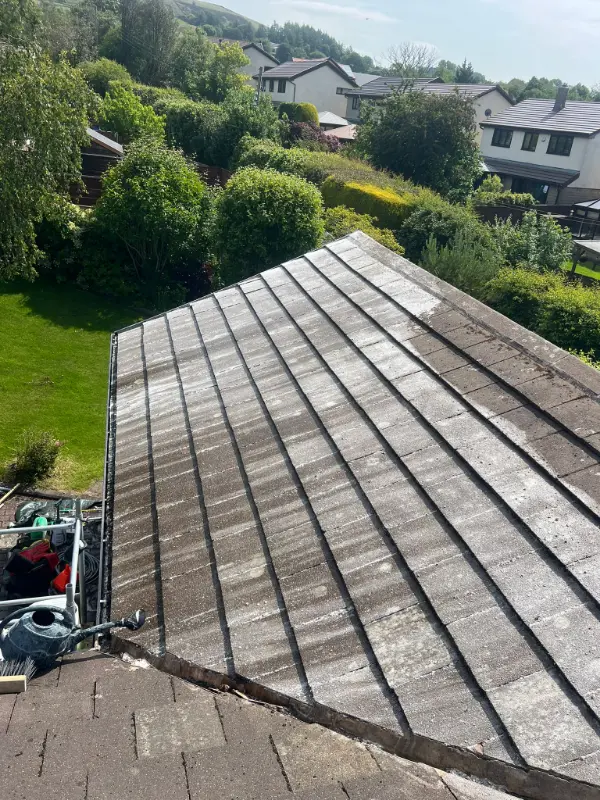
This imposing Victorian town house occupies a prominent position on Highgate, one of Kendal's most visible streets. The front-facing roof slope, pitched at approximately 45 degrees, was covered in Rosemary clay plain tiles — a traditional double-lap system requiring approximately 60 tiles per square metre. Over the years, frost damage and general weathering had cracked or broken around 30 individual tiles, allowing water to bypass the double-lap and soak into the lime mortar torching beneath. The lime mortar itself had largely turned to powder, leaving tiles held in place by nothing more than their own weight. The western verge had lost most of its mortar bedding, with tiles visibly slipping outward and threatening to fall onto the pavement below. Most critically, the valley gutter where the front slope met the rear wing had completely failed — the original lead lining had split along a fold line, and someone had previously attempted a repair using roofing felt and mastic, which had predictably failed within a season. Water was running directly into the upper-floor bedroom wall, causing serious damp and early plaster failure.
Rather than strip the entire front slope — which would have been disproportionately expensive for this largely sound roof — we carried out a targeted restoration approach. First, we erected scaffold across the full Highgate frontage with pavement protection fans to safeguard pedestrians. We then systematically worked across the slope from eaves to ridge, replacing every cracked or broken tile with carefully sourced reclaimed Rosemary plain tiles that matched the originals in colour, texture, and thickness. Where adjacent tiles had slipped due to failed nibs, we re-hung them on new stainless steel nails. The entire western verge was stripped back and re-bedded using a sand, cement, and lime mortar mix, with each tile mechanically clipped for additional security. For the critical valley repair, we stripped out the failed lining completely, checked the valley boards for soundness, and installed a new Code 5 lead valley dressed to a 125mm minimum upstand on each side. Finally, the ridge tiles along the front slope were re-bedded with fresh mortar, as the existing bedding had cracked in several places.
The restored front elevation now presents a clean, uniform appearance entirely in keeping with the Victorian character of the property and its Highgate neighbours. The lead valley provides a permanent, maintenance-free solution to the chronic leak that had been causing so much interior damage, and the homeowner reported that the bedroom damp dried out completely within six weeks of completion. The verge is now secure against even the strongest winds funnelling up the Kent valley, and the re-bedded ridge will provide reliable protection for at least 20-25 years. This careful restoration approach saved the homeowner approximately 40% compared to a full strip and re-tile, while still addressing every fault on the roof. Our tile roofing team takes particular pride in this kind of heritage-sensitive work across Kendal.


Rosemary plain tiles are a classic British clay tile with a distinctive camber and granular surface texture. For this Kendal restoration, we sourced reclaimed examples from a specialist yard to ensure an authentic match with the 100-year-old originals. Each replacement tile was individually selected for colour consistency, surface texture, and dimensional accuracy — a process that takes considerably more time than using new tiles but produces a vastly superior aesthetic result on a prominent period property. Clay plain tiles are exceptionally durable, with many examples surviving well over 150 years in service.
The replacement valley lining was formed from Code 5 milled lead to BS EN 12588 — at 2.24mm thick, this is heavier than the Code 4 used in less demanding applications, providing greater resistance to thermal fatigue in this long, exposed valley run. Each section was carefully bossed to shape on site using traditional leadwork techniques, with welted joints between sections to accommodate thermal movement without splitting. Code 5 lead in this application has an expected lifespan well in excess of 100 years.
All mortar work — verge bedding, ridge bedding, and torching — used a traditional 3:1:0.5 sand-cement-lime mix. The addition of hydrated lime provides essential flexibility, allowing the mortar to accommodate the slight thermal movement of tiles and timber without cracking. This is particularly important on a tile roof in Kendal, where winter temperatures regularly drop below freezing and the freeze-thaw cycle places enormous stress on rigid mortar joints.
All replacement tile nails and verge clips were A2-grade stainless steel, ensuring zero corrosion risk for the full lifespan of the roof repair. On a period property where the next intervention may not occur for decades, the small additional cost of stainless fixings provides invaluable long-term security against tile slippage.
From plain tile restorations on period properties to modern interlocking tile repairs, Mr Roofer UK delivers expert tile roofing services across Kendal and South Lakeland. We understand the architectural character of Kendal's historic streets and take pride in sympathetic repairs that preserve the appearance of your property. Contact us today for a free survey and quotation on any roof repair project.


Choose which cookies you are happy for us to use. You can change your mind at any time from the Cookie settings button.
Needed for the website to work and to keep it secure, for example remembering your cookie choices, keeping a basket or booking together and protecting forms from spam. These are always on.
Remember choices you make, such as how a list is displayed, so the site works the way you prefer.
Help us understand how visitors use the website so we can improve it.
Used by third-party services such as maps, videos and social media, which may track you across other websites.